On a sunny school day in May, Carlito Dominguez, a ninth grader at Sto-Rox Junior/Senior High School, was standing at the practice area of the Arnold Palmer Learning Center next to the Bob O’Connor Golf Course in Schenley Park with a small group of classmates.
For two school years, Carlito has come here as part of a First Tee-Pittsburgh (FTP) program working with students who struggle with attendance, using golf to build confidence and life skills.
“I’ve just really enjoyed it here,” he said, gesturing broadly at the leafy landscape around him. “I learned how to hit the ball. It ain’t easy. Being outside, it definitely helps me feel better, it helps me focus a lot,” he added, agreeing that he feels the difference back at school, too.
Carlito was delighting in one of Pittsburgh’s oldest public assets — a golf course more than a century old, now operated by a nonprofit whose mission extends well beyond the sport.

First Tee-Pittsburgh enters this golf season seeking to reshape its future, stabilize its finances and demonstrate whether a golf course can be something more than a golf course. The public complex is part of a park that sits on the National Register of Historic Places, and was also recently designated as a Pittsburgh historic landmark, giving it a layer of protection. Yet, for some neighbors, the planning process to date has felt too fast for a place they have come to love.
At a standing-room-only community meeting in March about the golf course’s plans, Post-it notes dotted walls and paper plans, while FTP’s leadership promised visualizations and details to come. One resident, though, called FTP’s ideas “the commercialization by golfing interests of a beloved community park that so many of us enjoy walking, with peace and quiet,” only to be interrupted by another who queried: “But have you enjoyed it as a golfer?”
First Tee’s plan for the future
First Tee-Pittsburgh [FTP] operates the Bob O’Connor Golf Course — known locally as “The Bob” — and the Arnold Palmer Learning Center under a $1-a-year lease with the city running through 2035, with the option of an extension until 2045. The Bob is named after Mayor Corey O’Connor’s father, a former city councilor, mayor and avid golfer, just like his son. Bob O’Connor, a stalwart advocate of the course, helped transition it away from city management.

The Bob is one of nearly 3,000 municipal courses remaining in the United States, according to the National Golf Foundation — a substantial number, but down around 13% from two decades ago.
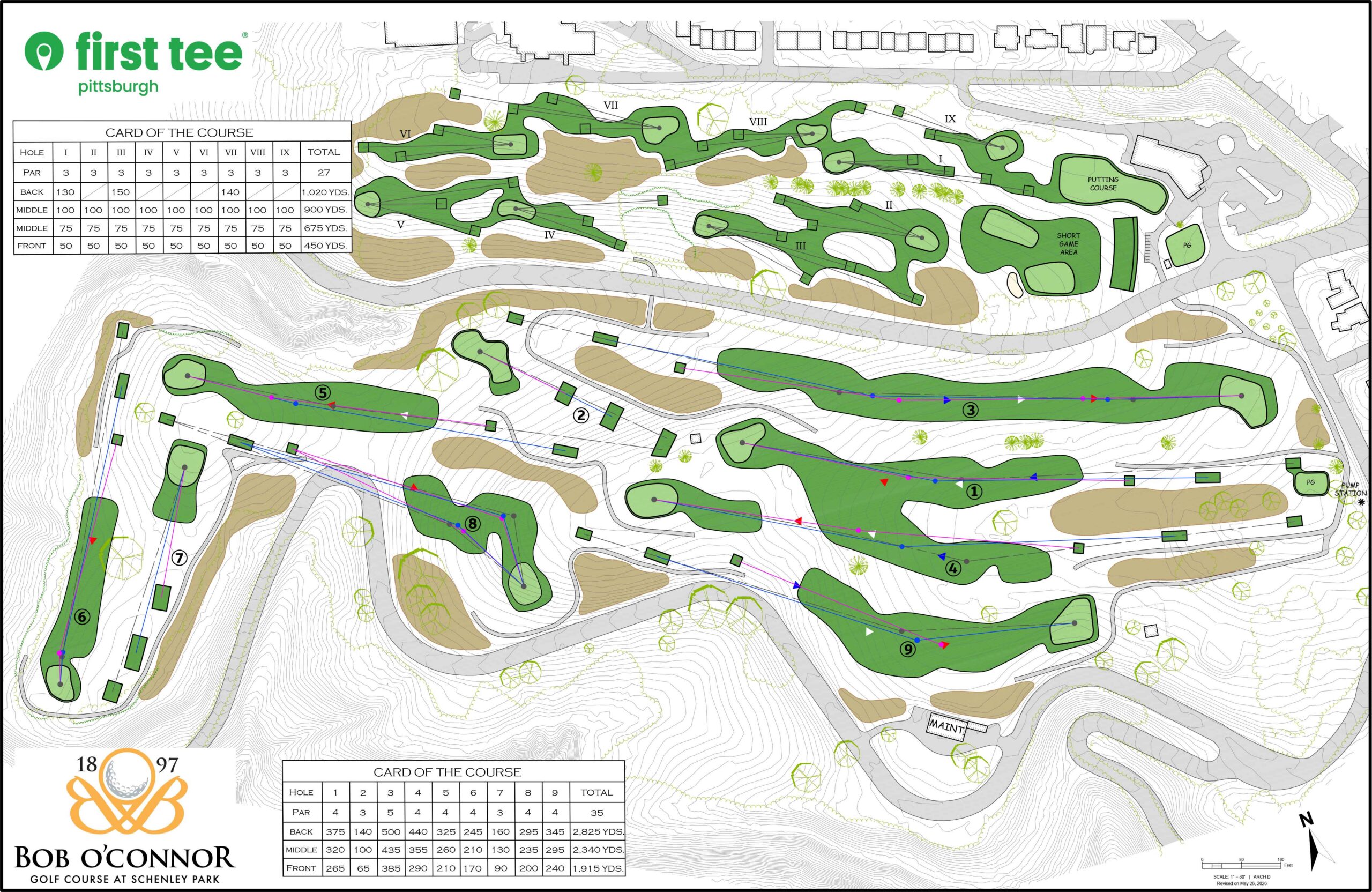
Since late last year, FTP has been pitching a vision plan, “Forging Our Future,” for the now walkable-only course, to modernize aging infrastructure, expand youth programming and achieve sustainable revenue by the 2035 lease’s end.
FTP, a nonprofit organization, runs The Bob at a loss of approximately $100,000 a year, according to President, CEO and First Tee-Pittsburgh Coach Eric Amato. The organization’s filings with the IRS for 2024 indicate revenue of $1.78 million and expenses of $1.97 million.
FTP pays its own water bill, operating costs are rising, and it is responsible for the 33-year-old outdated irrigation system. It has to maintain its five-year-old, $6.5 million building.
Two features anchored the proposal’s revenue model: a new electric golf cart fleet and a full-swing performance center, or driving range, projected to increase net operating income to $574,000 by 2035, with the profits expanding youth programming and scholarships. One of those revenue streams is now off the table.

The driving range could have required netting on metal poles rising 40 to 90 feet or more against Schenley Drive, a road on which signs already warn, “Drive at your own risk.” That net, and related traffic concerns, were among residents’ objections at the March meeting.
Amato told Pittsburgh’s Public Source that FTP would abandon the traditional range.
It is the organization’s third concession. FTP agreed to no alcohol service nor night lighting after community pushback, despite liquor sales being a revenue driver at courses nationally. Instead, golfers will be urged to patronize Squirrel Hill’s business district at the end of play.

What remains — gleaned from consulting architect Jason Sloan’s designs — includes eco-friendly irrigation and an electric cart fleet supported by a parking lot, cart barn and cartways. Earth work throughout may include a Himalayan-like putting green, a dramatically contoured short-game practice area sited near the learning center and within the vicinity of the private, historic Pittsburgh Golf Club, whose view of the course will be restored by excision of a border screening hedge. Tree culls will need to be offset by replacements elsewhere, and new areas of native plantings to aid stormwater management are in line with the learning center’s existing Audubon Cooperative Sanctuary Golf Course certification.
Amato puts the project total at roughly $10 million, including $2 million for irrigation replacement, and seeks to fund it through private donations, acknowledging that elements like a final cart barn design may change projections.
Neighbors want more detail
Schenley Park’s 456 acres function less as a single green space than a collection of distinct destinations: The Oval, Phipps Conservatory, the skating rink, Flagstaff Hill, Schenley Plaza, the Frick Fine Arts Building and the Neill Log House. Some are managed by separate entities under contracts with the city. The Bob takes up 55 acres.
Neighborhood response has focused on a perceived lack of detail about FTP’s plans and a process that some say feels too confusing and too quiet. At the March public meeting, following FTP’s presentation, Ken Levin, a Squirrel Hill resident, asked quizzically: “On the nine hole, how much is changing and how much are you keeping the same?”

Some told the Trib that they were concerned about loss of greenspace and wanted more community engagement.
Friends of Schenley Park wrote to city Department of Public Works Director John McClory on April 20, asking for public involvement in any lease renegotiation.
City Councilor Erika Strassburger, whose district includes northern parts of Squirrel Hill, said she heard from residents, and while some concerns have eased, “others will probably remain concerned until First Tee is able to share their consultant’s renderings and drill down into the details more granularly.”
The Squirrel Hill Urban Coalition is a Registered Community Organization and has the right to be briefed on development that requires city approval. SHUC has been informally facilitating discussions without taking a position in “a pro-active, good-faith effort to help bring more information to the community, prior to any formal processes,” emailed Lori Fitzgerald, who sits on both the SHUC and Neill Log House boards. The Neill Log House is adjacent to the course and a “tenant” of FTP’s water service.
City Councilor Barb Warwick is on the FTP board, a position encouraged in the original lease because her district encompasses the course. Warwick said she appreciates constituent worries of a “slippery slope” of change. “There needs to be a little bit more clarity from First Tee,” she said.
The lease dictates that the city Community Affairs Office must schedule community meetings. “The office has been attending,” wrote Molly Onufer, spokesperson for the mayor, but since “no formal proposal has been submitted to the city, they have not planned or scheduled any.”

The Pittsburgh Parks Conservancy, a private city partner fundraising for park projects since 1996, was not part of the visioning process until it became more public. The conservancy didn’t know about the plan until March, said Alana Wenk, director of marketing and communications. “We believe it is important that the public has meaningful opportunities to share perspectives and participate in conversations about the park’s future,” Wenk later wrote.
In May, after removing the driving range, Amato emphasized to Public Source that “the vision and our commitment to this work remain unchanged and that includes keeping our partners informed of our progress.”
First Tee-Pittsburgh’s promise
FTP operates under the umbrella of the national First Tee program, and its primary mission is to empower children and teens by teaching them golf. Around 15% of the 1,743 kids served in 2025 came from underserved communities, with the largest being the McKees Rocks area. First Tee has a facility there in partnership with the Allegheny County Housing Authority.
“Most of our kids in McKees Rocks aren’t gonna ever play golf,” said Brittany Linsenbigler, Sto-Rox director of student services. “They won’t have this exposure to this experience. So this program was really great to get them out of their comfort zone and see some different walks, paths. It gives them a sense of accomplishment.”
The Sto-Rox attendance officer selects students for the program, which is like an honor, Linsenbigler added, and in turn he also “gets a chance to make connections with the parents and be a more positive influence.”
Amato said FTP serves kids in Allegheny, Butler, Beaver, Washington and Westmoreland counties. Diversity and inclusion, also of female golfers, are priorities.

In 2025, FTP reached another 20,000 kids through outreach, school programs and one-time events, Amato said.
FTP’s Ready “Fore” Work caddie program gives high schoolers hands-on experience — event management, course operations, caddying — with summer pay and bus passes. Broadly, the program tries to develop, in tiers, social skills, industry exposure and scholarship.
Asked whether he planned to join the caddie program, Carlito smiled, a twinkling in his eyes and a slight upward bounce as he turned toward the practice area, a foot pointing toward his clubs and peers. “Yeah,” he said. And as for sticking with the program all the way until 12th grade, “I hope I can.”
Carlito told Amato he wants to be a paleontologist.
FTP isn’t just for kids. It teaches adults year-round, works with veterans and welcomes new and repeat customers daily both to the nine-hole “Bob” and the three-hole Palmer practice loop. Trackman simulators inside the building can be rented to build skills similar to those gained at a driving range, even in inclement weather.
Strassburger, who is not a golfer, toured the facility for the first time recently and was impressed by the focus on youth and “working them up the leadership ladder.” Golf, she said, “is just the hook.”
What would it cost, and who would pay?
Running a golf course — even one focused on kids — is expensive, and so far the math doesn’t work for The Bob. Organizational expenses outstripped revenues by $111,144 in 2022, $169,836 in 2023 and $191,303 in 2024, slowly bleeding the cash balance, according to disclosures to the IRS. First Tee-Pittsburgh makes up what The Bob loses, Amato confirmed.
The Arnold and Winnie Palmer Foundation donates to First Tee and FTP. Arnold Palmer learned to play at a private club 40 miles away in Latrobe, but his name helps fundraise. Like most nonprofits, FTP does not list all donors on its IRS disclosures.
The city gave around $1 million toward the construction of the Arnold Palmer Learning Center from 2012 to 2018, but it now contributes only $44,000 to FTP annually, which the nonprofit must match. The city also shares a shed, fuel and equipment.

Some park partners receive Regional Asset District funding from Allegheny County’s 1% sales tax. The Bob does not. Rachel Handel, RAD communications director, said that new applications are accepted each year, with 2027 funding applications due June 24.
Parks tax funds go to the city and some flow to the Pittsburgh Parks Conservancy. Asked whether FTP could be eligible for some of that money, Wenk said the city ultimately decides what the tax covers, adding: “We’re always open and happy to sit down and talk and listen and figure out plans that are best for the park.”
FTP had pinned some of its hopes on the driving range and golf cart rentals. Cart revenue would largely depend on the rental fee and how many rounds of golf are played annually. How FTP replaces the lost range revenue is not yet settled. The organization is exploring alternative models aligned with community input, said Amato.
And if First Tee-Pittsburgh were to fail?
In the event of a lease termination by either party, the city would become responsible for The Bob and all of First Tee-Pittsburgh’s enhancements from irrigation to the learning center and outdoor classroom.
Next steps for the course, its clients
Golfers and walkers have a shared stake in the park. They’ll have opportunities to weigh in even before any designs are finalized or the permit process begins.
Since the March meeting, FTP has interviewed civil engineering teams following a request for proposals, and Amato said they “expect to have them named in the coming weeks.” The nonprofit has also pledged to do a traffic study in collaboration with the city’s Department of Mobility and Infrastructure.
On June 16, the Squirrel Hill Urban Coalition will hold its next open board meeting, though the project is not on the agenda. Friends of Schenley Park held its first formal meeting in April and has scheduled another for July 15.
Christine Graziano is an independent writer and can be reached at christina@molnar-media.com.
This story was fact-checked by Ada Perlman.
MOST READ STORIES