This story was originally published by Kidsburgh.org, a media partner of Public Source. Kidsburgh is an online resource for families that highlights stories about the people, organizations and events making Pittsburgh a better place to raise all kids. Sign up for Kidsburgh’s free e-newsletter.
A student can be homeless and still show up for first period. They can sit beside your child in class after spending the night with relatives or friends. They can arrive late because the temporary place they slept is nowhere near their school.
And amid all that uncertainty, they can still be thinking about college, careers and who they want to become.
“There were times when I did not know where I was going to sleep or how I was going to get to school, but I still had goals for my future,” says Jordan, a local college student whose name has been changed to protect his privacy.
Jordan’s experience is one of the stories behind “Echoes of Brilliance,” a new collection of essays and artwork from young people who have experienced homelessness and housing instability, published by Pittsburgh-based Homeless Children’s Education Fund. The book asks readers to see what the label “homeless” can easily obscure: the rest of a child’s life.

Students applying for HCEF’s multiyear Hope Through Learning Award scholarships submit essays about their experiences, goals and hopes for the future. As HCEF President and CEO AJ Jefferson and her colleagues read them, they found themselves returning to the students’ words long after the applications had been reviewed.
“We were reading these incredible stories about what they had lived through, what they wanted for their futures and what kept them going,” Jefferson says.
Staff began sharing anonymized excerpts from the essays during special meetings. Hearing the students’ words aloud changed something. “Hearing their words spoken in a room full of people hit differently,” Jefferson says. “These young people had trusted us with something sacred. Their words deserved a life beyond an application.”
It also raised a question: Why should those stories disappear once a scholarship committee had read them? The answer became “Echoes of Brilliance.”
Changing who holds the microphone
Pennsylvania Department of Education data identified 3,952 children and youth experiencing homelessness in Allegheny County last year, including 1,156 in Pittsburgh Public Schools. Both figures increased from the previous year, Jefferson says.

But numbers can also flatten what “Echoes of Brilliance” is trying to shed a light on.
“Adults spend a lot of time explaining young people,” Jefferson says. “We describe them, interpret their experiences and turn their lives into statistics.”
With this book, she says, “We get out of the way. These aren’t stories written about our students. They’re written by them. The fear is there, but so is humor. Love. Anger. Hope. Ambition. Brilliance. You stop seeing ‘a homeless child’ and start seeing a whole human being.”
That is important because student homelessness itself can be difficult to see. A child experiencing homelessness might be living in a shelter. But they might also be sharing a relative’s or friend’s home after their family lost housing, staying in a motel or moving between temporary places. They may not know where they will be sleeping next week.
“And that child may still get up tomorrow, put on a backpack and sit beside your child in school,” Jefferson says. “There isn’t a prototype of a child experiencing homelessness.”
What homelessness can look like from a school desk
For Jordan, it looked like two house fires. One happened while he was in elementary school and another while he was in high school. Each displaced his family and forced them to rely on temporary places to live.

By the second fire, Jordan was old enough to understand exactly how unstable life had become. Moving between temporary homes made routine difficult. Sometimes he was worrying about where he would stay. Sometimes it was how he would get to school. Sometimes it was simply what would happen next.
“I wish they understood that I was dealing with things outside of school that were much bigger than missing an assignment or not being able to participate the way I normally would,” Jordan says. “Even though I was physically sitting in a classroom, my mind was sometimes somewhere completely different.”
Housing instability, Jefferson says, can destabilize almost everything that makes learning possible. “Think about everything stability makes possible,” she says. “Sleep. A quiet place to do homework. Knowing where your clothes are. Transportation. Staying in the same school. Friendships. Knowing where dinner is coming from. Now imagine trying to learn while some of those things keep changing.”
Jordan remembers the less visible logistics: Transportation could become uncertain, so could where to keep his belongings, eat or shower. Even charging a phone, getting online or finding somewhere quiet enough to work could become a problem. “When you are constantly trying to figure out your basic needs, it can be hard to focus on school,” he says.
The educational consequences show up in statewide data, too. According to the Pennsylvania Department of Education, half of Pennsylvania students identified as experiencing homelessness are chronically absent. Only 22% are proficient or above in reading and 14% in math, compared with 50% and 42%, respectively, among the general student population.
Jefferson says the numbers should prompt curiosity rather than judgment. When a student repeatedly misses school, stops completing assignments or struggles academically, “I want us to resist making assumptions about motivation or ability,” she says. “The data tells us there is an educational consequence to instability. But it does not tell us anything about a child’s brilliance.”

Instead of asking, “What’s wrong with this child?” she says, adults might ask: “What’s happening around this child, and what do they need to keep moving?”
Jordan wishes someone had. “I wish someone had noticed that I was struggling and asked me what was going on instead of assuming that I was okay,” he says. “Sometimes when you are going through something difficult, you do not know how to ask for help, or you may be embarrassed to explain your situation.”
Sometimes help begins with ‘Are you OK?’
The adults Jordan remembers most are not necessarily the ones who made enormous interventions. Someone listening, checking in or reminding him that he was capable could matter.
“The people who helped me the most were the ones who treated me like a person instead of looking at me differently because of my circumstances,” he says. “Sometimes support does not have to be something huge. Having a teacher or another adult simply ask, ‘Are you okay?’ or ‘Is there anything you need?’ can mean a lot when someone is going through a difficult situation.”
Jefferson argues that effective support also has to extend beyond the immediate emergency. A student might need transportation, tutoring, food, clothing or help navigating school. But providing one of those things once is different from creating stability. “The biggest difference is continuity,” she says.

That philosophy has shaped HCEF’s effort to work with young people from childhood through preparation for careers. “A young person shouldn’t receive help during one crisis and then have to start over when the next transition comes,” Jefferson says.
Allegheny County has schools, nonprofits, government agencies, employers and funders doing this work, Jefferson says. What remains difficult is connecting them around the same child. “The gap I continue to see is fragmentation. Stability isn’t a moment. It’s a sequence.”
How do you publish a child’s story without taking it from them?
Kaitlyn Nykwest, HCEF’s vice president of operations, worked with Jefferson and the program team to review stories students had already chosen to share through the Hope Through Learning Awards. Nykwest made an initial pass through the essays and also helped select artwork HCEF had saved from students over the years.
But inclusion in a scholarship application did not automatically mean permission to publish. Once HCEF decided to make the book, its teen program staff returned to the students to ask whether they wanted their work included, Nykwest says.
Every student’s process had been different. Some had worked with HCEF staff and volunteers while developing their writing; others wrote independently.
“We follow their lead in what they’ve decided to share and how they choose to share it,” Nykwest says. “It takes courage to share your story, and we do our best to honor our students by sharing their stories in their own words.”
The artwork developed even more organically. HCEF had collected it from students over many years and in many settings. Some pieces were responses to workshops; others came from events or individual moments of creativity.
Placed together, the essays and art began to reveal a through-line that Nykwest had seen repeatedly in HCEF’s work: Students wanted people to understand their challenges, but they also wanted their strengths to be visible. And some understood telling their own story as a form of advocacy.
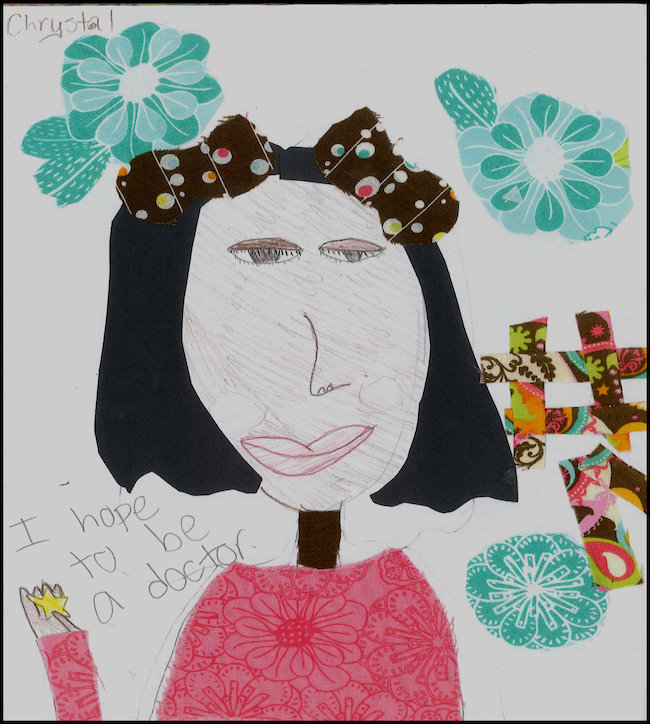
One student explained the impulse this way: “I hope to help others feel seen, supported and less burdened.”
Jordan felt that responsibility, too. Sharing his experience was difficult, he says, because deciding what to disclose meant returning to deeply personal moments. But he ultimately chose to participate because another young person might recognize themselves in it.
“I wanted people to understand that homelessness and housing instability can happen to anyone, and that it does not define who you are or what you can become,” he says. “In the end, I felt that sharing my experience could help someone else feel less alone.”
The lives happening alongside homelessness
Jefferson says one thing stayed with her after reading the students’ work: just how much else was happening in their lives. There were house fires and deaths in families. There was domestic violence. There were parents struggling to find stable jobs and housing. “But those experiences weren’t the entirety of their stories,” Jefferson says.
Students were thinking about college. Careers. Their families. Their futures.
“Housing instability interrupted their lives,” she says. “It didn’t erase their vision.”
That is why the word “brilliance” matters in the book’s title. “HCEF didn’t put the brilliance in these young people,” Jefferson says. “It was already there. Homelessness is something a child experiences. It is not who that child is.”
A child, she says, “can be homeless and brilliant. Homeless and funny. Homeless and ambitious. Homeless and deeply loved. Homeless and already imagining a future bigger than their present circumstances.”
For Jordan, that imagined future is becoming increasingly concrete. He is now in college and working toward a career in the fire service. He hopes to continue his education, grow within the profession and eventually move into leadership.
The two fires that once upended his own life have also changed how he sees people when he arrives at someone else’s emergency. “As a firefighter, I get to respond when people are experiencing some of the worst moments of their lives,” Jordan says. “I understand that there is usually more to someone’s situation than what you see when you arrive.”
And when asked what he would tell a young person who is now living through the kind of uncertainty he once did, Jordan has an answer. “Hold on to your goals, even when they seem impossible,” he says. “Keep going to school, keep learning, and surround yourself with people who believe in you. Your story is not over just because you are going through a difficult chapter. I am proof that where you start does not have to determine where you finish.”
Aakanksha Agarwal is a wine, travel and lifestyle writer from India. Formerly a Bollywood stylist, she now resides in Pittsburgh, can be reached at aakanksha.agarwal1988@gmail.com.